
FOR THE FIRST TIME IN THE LUGANO REGION
Two instruments, one listening
Overlooking the waters of the Ceresio, within the intimate silence of Gandria, the Church of San Vigilio preserves within its forms the stratification of different eras: medieval traces, Baroque interventions and transformations that tell the story of a place slowly built over time.
The dedication to the saint-bishop of Trento recalls the ties that, already in the Middle Ages, connected these lands to the great artistic and cultural routes beyond the Alps. Masters, craftsmen and builders crossed mountains and cities carrying with them techniques, images, languages and different ways of conceiving space. In this small village suspended above the lake, the sign of that vocation for travel, exchange and shared construction still remains today.
It is precisely within this space that tonight’s concert takes shape, built around the encounter between violin and guitar: two instruments profoundly different in nature and sonic projection, yet capable of creating a surprisingly natural balance.
With the Gran Duo Concertante by Mauro Giuliani, the programme opens within a luminous and elegant dimension. The dialogue between the two instruments immediately appears fluid and mobile: the violin sings with momentum and natural cantabile expression, while the guitar supports, relaunches and continuously transforms the colour of the writing. Nothing appears rigid or hierarchical; everything lives through the movement of phrasing and the quality of reciprocal listening.
With Niccolò Paganini, the discourse changes perspective. The first Sonata from the Centone moves through a freer and more unpredictable territory, almost improvisatory in character. The introduction opens a suspended space, immediately crossed by rhythmic energy and theatrical lightness, while the final Rondoncino flows with natural brilliance, like a thought changing shape in the very moment of its birth.
The Cantabile, on the other hand, represents a brief suspension of time. The writing becomes more inward, the sound lighter, and everything seems concentrated within the purity of the melodic line. It is music that does not seek external virtuosity, but rather an almost vocal simplicity — intimate and disarming.
In the Sonata concertata, the dialogue between violin and guitar expands even further. The first movement preserves a fluid and spontaneous brilliance, while the Adagio introduces a more intimate and introspective dimension made of restrained breaths and continuous sonic chiaroscuro. The finale instead restores movement, lightness and theatrical spirit, fully returning that natural vitality which runs through the entire programme.
Bringing the journey to a close are the celebrated Variations on the Carnival of Venice, where Paganini transforms an extremely simple popular theme into a continuous game of sonic metamorphoses. Virtuosity multiplies itself, sound constantly changes face and the music seems to delight in reinventing itself through elegance, irony and spectacular brilliance.
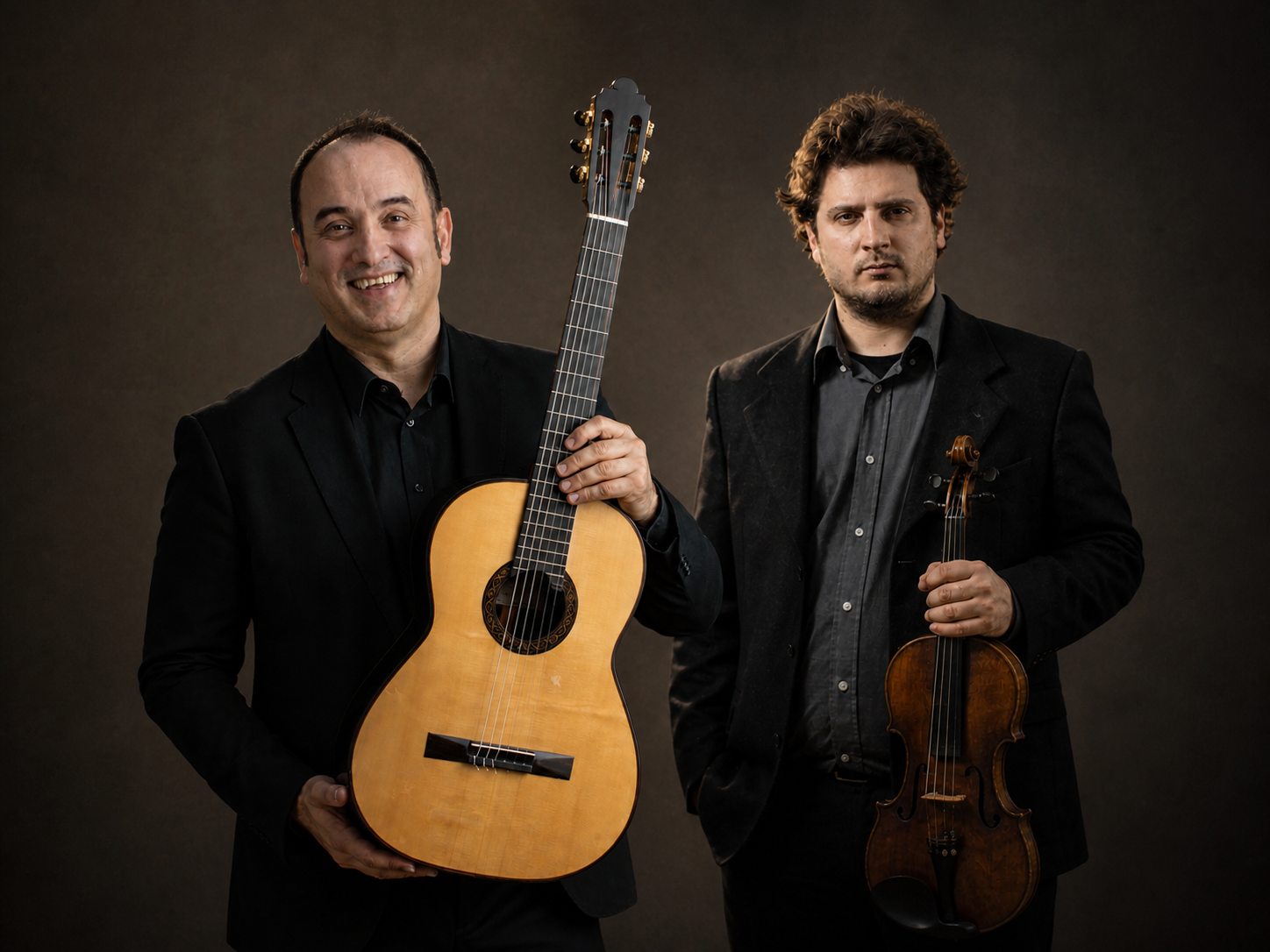

Giving shape to this musical itinerary are Matteo Calosci and Giulio Tampalini, two performers who know this repertoire profoundly and share its most natural breath.
Giulio Tampalini is today one of the most recognised figures in Italian classical guitar. Alongside his intense international concert activity, he has for years pursued important work of research and repertoire rediscovery, restoring to the guitar a voice that is full, autonomous and surprisingly broad in its expressive possibilities.
Matteo Calosci, trained in Italy and refined in high-level musical contexts, finds in chamber music a particularly congenial dimension. His violin combines precision, luminosity and constant attention to the quality of musical dialogue.
Within their encounter, no hierarchy exists. The violin does not impose itself, the guitar does not simply accompany: sound instead arises from a continuous search for balance, space and reciprocal freedom. And it is precisely within this naturalness — never ostentatious and always alive — that music rediscovers its most authentic dimension.
BIOGRAPHIES
Matteo Calosci
Italian violinist, pedagogue and artistic promoter Matteo Calosci is linked to the prestigious school of Zakhar Bron. He is professor of violin at the Rossini Conservatory in Pesaro, founder of the Accademia Violinistica di Padova, artistic director of the ClassicAncona Festival and president of Young Artists Promotion. He performs as a soloist and chamber musician in Italy and abroad, with particular attention to the training of young talents and to chamber repertoire.
Giulio Tampalini
Regarded as one of the most important Italian guitarists of his generation, Giulio Tampalini has given more than two thousand concerts worldwide and is the winner of numerous international competitions. A professor at the “Gaetano Donizetti” Conservatory in Bergamo and at the Fondazione International Academy in Imola, he is a Warner Classics artist and has recorded a vast repertoire, making a significant contribution to the appreciation of the classical guitar from the nineteenth-century repertoire to the twentieth century.